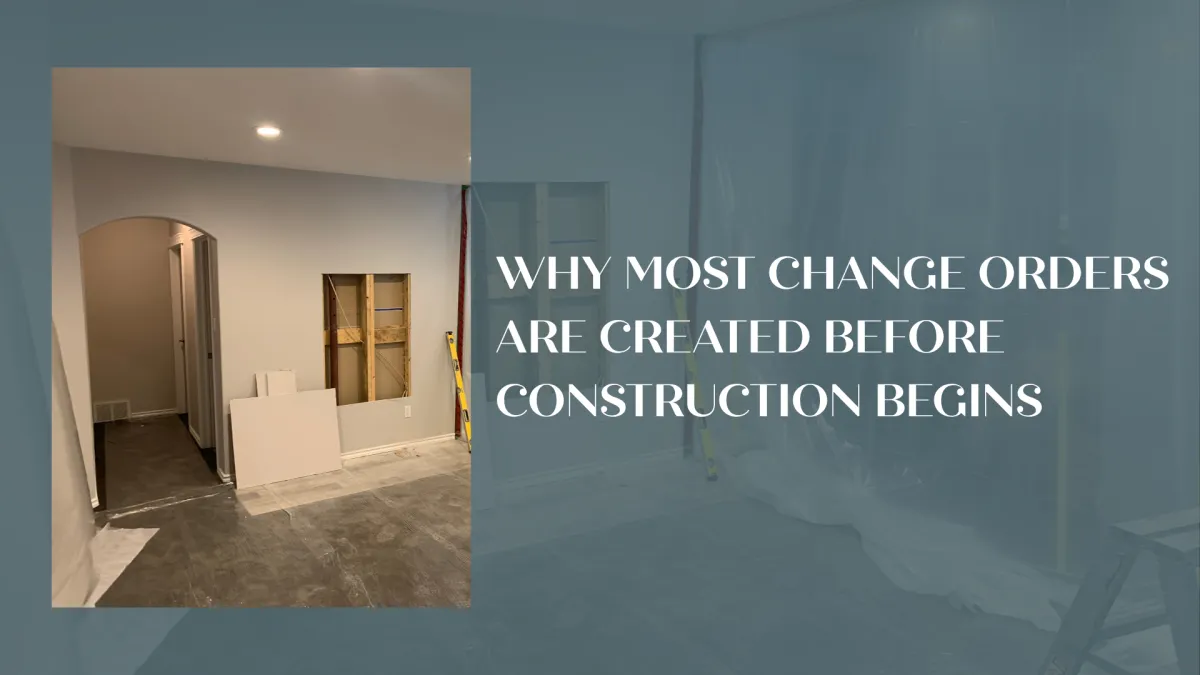
Why Most Change Orders are Created Before Construction Begins
Before You Build Series | Part 2 of 5
Missed Part 1? Read: Why Most Construction Problems Start Before Construction Begins
https://handley.ca/post/Why-Most-Construction-Problems-Start-Before-Construction-Begins
Few words create more anxiety during a construction project than "change order."
Most clients assume change orders happen because a contractor made a mistake, uncovered hidden damage, or missed something during construction.
Sometimes that happens.
More often, change orders are created long before construction starts.
After nearly two decades in the construction industry, we've seen the same pattern repeatedly. The projects with the most change orders rarely have the worst trades or the most complicated designs.
They have unclear scope.
When decisions are delayed, assumptions are made, or project details remain unresolved before construction begins, change orders become almost inevitable.
The good news is that most of them can be reduced through proper planning.
WHAT IS A CHANGE ORDER?
A change order is any modification to the original scope of work after a project has already been approved and construction has begun.
This could include:
Additional work requested by the client
Material upgrades
Layout changes
Design revisions
Scope additions
Unforeseen site conditions
Not all change orders are bad.
Sometimes a homeowner changes their mind about finishes.
Sometimes an investor decides to upgrade materials.
Sometimes site conditions reveal information nobody could have known beforehand.
The problem occurs when change orders become the standard operating procedure instead of the exception.
THE REAL CAUSE OF MOST CHANGE ORDERS
Most change orders begin with one of three problems:
1. Scope Was Never Fully Defined
A contractor cannot accurately price work that has not been clearly defined.
When project details remain unresolved, assumptions fill the gaps.
Those assumptions eventually become change orders.
Examples include:
Cabinet layouts not finalized
Flooring selections not confirmed
Fixture allowances left open
Incomplete renovation scope
Missing design details
Every unanswered question creates risk.
2. Decisions Were Made Too Late
Construction moves quickly.
The later a decision is made, the more expensive it becomes.
Changing a paint colour is easy.
Changing plumbing locations after rough-ins are complete is not.
Changing a tile selection before ordering is simple.
Changing it after installation has started is expensive.
The earlier decisions are made, the fewer disruptions occur throughout the project.
3. Trades Were Not Aligned
Every trade depends on the work completed before them.
If one trade is working from different information than another, problems follow.
We've seen projects where:
Electricians received outdated plans
Cabinet suppliers worked from different dimensions
Material selections changed after ordering
Schedule adjustments were never communicated
These situations create delays, rework, and unnecessary costs.
Proper coordination prevents them.
WHY THE LOWEST QUOTE OFTEN CREATES THE MOST CHANGE ORDERS
One of the most common misconceptions in construction is that the lowest quote represents the lowest cost.
Often the opposite is true.
A low quote may simply mean critical details have not yet been accounted for.
When those details eventually surface, they become change orders.
The initial number looks attractive.
The final number tells the real story.
This is why experienced clients focus less on the lowest price and more on the quality of the planning behind it.
THE HANDLEY APPROACH
At Handley Construction, reducing change orders starts during preconstruction.
Before construction begins, we focus on:
Scope Development
Every major project component is reviewed and documented.
Selections and Approvals
Materials, finishes, and project decisions are confirmed before work begins.
Trade Coordination
Trades receive clear information before arriving onsite.
Schedule Planning
Dependencies are identified before they become delays.
The objective is simple:
Make decisions early.
Solve problems before they become expensive.
Create clarity before construction begins.
FOR INVESTORS: CHANGE ORDERS IMPACT RETURNS
For investors, change orders are more than an inconvenience.
They directly affect profitability.
Every unexpected cost reduces return on investment.
Every schedule delay postpones occupancy.
On a multi-family project, even a one-week delay can affect financing costs, push back occupancy dates, and reduce projected returns.
Every scope revision creates additional project risk.
A structured planning process helps protect both timelines and budgets.
That is why serious investors place such a high value on preconstruction.
FOR HOMEOWNERS: CHANGE ORDERS CREATE STRESS
For homeowners, construction is personal.
Unexpected costs create uncertainty.
Repeated decisions create frustration.
Deciding on tile, cabinetry, or fixtures after demolition has already started is one of the most common and costly situations we see.
Constant revisions make the project feel out of control.
A clear plan removes much of that stress.
When decisions are made upfront, construction becomes significantly more predictable.
THE BOTTOM LINE
Most change orders do not begin during construction.
They begin during planning.
Clear scope.
Early decisions.
Trade coordination.
Organized preconstruction.
These are the factors that separate projects that run smoothly from projects that constantly require revisions.
Construction success starts before building begins.
Next in the Before You Build Series: Why the Lowest Quote Often Becomes the Most Expensive Project
READY TO START PLANNING?
Whether you're preparing for a major renovation, an infill project, or a multi-family development, the planning process will determine the outcome long before the first day of construction.
Book a site consultation with Handley Construction Inc. to discuss your project and learn how a planning-first approach can help create a smoother build experience.
Book a Site Consultation: https://handley.ca/booking-page
Email: [email protected]
Phone: +1 825-465-5133